
16MnCr5
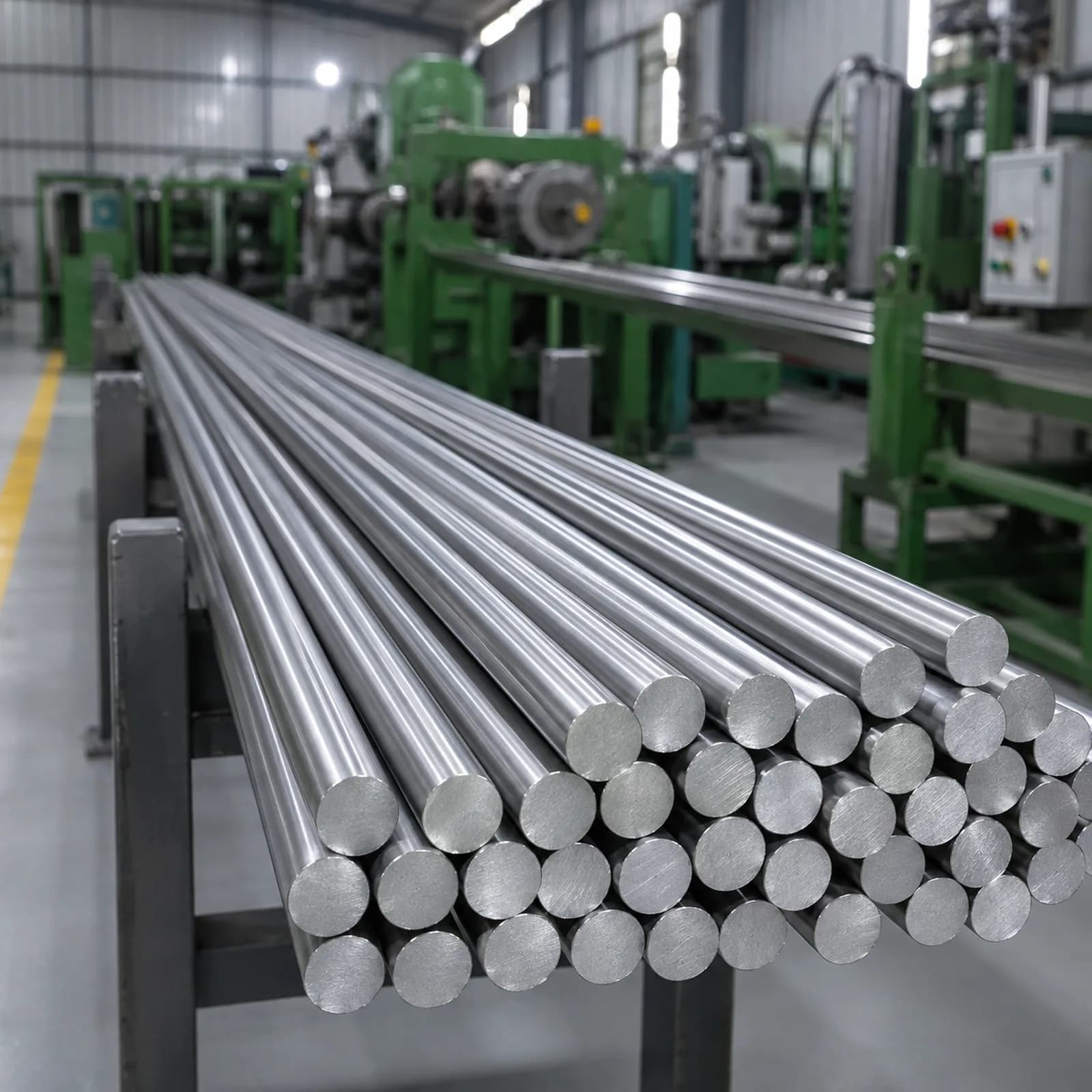
16MnCr5 Case Hardening Alloy Bright Bar
The standard carburising alloy — hard case, tough core, proven on gears.
Also known as 1.7131 · AISI 5115 · SCr415
Overview
What 16MnCr5 is, and where it belongs
16MnCr5 is the most widely used case hardening alloy steel in general gear and transmission work. The name describes it: roughly 0.16% carbon, manganese around 1.15% and chromium around 1% — Mn-Cr, hence 16MnCr5.
Low carbon in the base steel is deliberate. The part is machined soft, then carburised: carbon is diffused into the surface at 880–980 °C and the part is quenched. The carbon-rich case transforms to hard martensite at 58–62 HRC while the low carbon core stays tough and ductile. A gear tooth ends up with a wear-resistant flank over a core that can absorb shock without fracturing.
Chromium and manganese are what make this work at useful section sizes. They increase hardenability — the depth to which martensite forms during quenching — so the case hardens uniformly and the core develops proper strength even on larger gears. Plain carbon steel cannot do this.
For automotive supply chains that need documented, batch-to-batch consistency of hardening depth, the hardenability-controlled variant 16MnCr5H is the correct specification.
Chemistry
Chemical composition
As per EN 10084 / DIN 1.7131, certified per mill test certificate. Values are percentage by weight.
| Element | Symbol | Min % | Max % |
|---|---|---|---|
| Carbon | C | 0.140 | 0.190 |
| Silicon | Si | — | 0.250 |
| Manganese | Mn | 1.000 | 1.300 |
| Phosphorus | P | — | 0.035 |
| Sulphur | S | — | 0.035 |
| Chromium | Cr | 0.800 | 1.100 |
A dash in the minimum column means only an upper limit applies to that element.
Properties
Mechanical properties
Typical values in the Cold Drawn / Annealed (supplied soft for machining) condition. Certified values for your consignment appear on the test certificate.
- Hardness as supplied
- ≤ 220 HBAnnealed / soft, for machining
- Case hardness after carburising
- 58 – 62 HRC
- Core Tensile Strength
- 920 – 1150 MPaBlank carburised & hardened test, min per mill certificate
- Core Yield Strength
- 780 MPa minBlank carburised & hardened test
- Elongation (A5)
- 10 – 15%Core, blank carburised & hardened test
- Core Hardness (quenched)
- 29 – 43 HRCBlank carburised & hardened test — confirms through-hardening response
Availability
Sizes and tolerances
We draw 16MnCr5 across the range below. Exact availability for a given size is confirmed on enquiry.
Round bar
8 – 65 mm
Nominal diameter
Hex bar
10 – 46 mm
Across flats (AF)
Tolerance bands
All bands are ISO 286 ‘h’ — the bar is never above nominal size. See exact values for your size.
Where it is used
Typical applications
- Gears, gear blanks and pinions
- Transmission shafts and splined shafts
- Camshafts and rocker arms
- Bushes, pins and levers requiring wear resistance
- General automotive and machine tool components
Application guides
Cross reference
International equivalents
Nearest designations under other standards. Equivalents are close but rarely identical — check the specific requirement that matters for your part.
Full equivalents chart| Standard | Designation |
|---|---|
| DIN / EN (Germany) | 16MnCr5 / 1.7131 |
| AISI / SAE (USA) | 5115 |
| JIS (Japan) | SCr415 |
| BS (UK) | 527M17 / En207 |
| IS (India) | 16Mn5Cr4 |
Processing
Heat treatment guidelines
Indicative parameters. Actual cycles depend on section size, furnace and the properties your drawing calls for.
- 01Soft annealing650 – 700 °C, furnace cool — gives ≤ 207 HB for machining
- 02Normalising880 – 920 °C, cool in still air
- 03Carburising880 – 980 °C in a carburising atmosphere; case depth set by time and temperature
- 04HardeningDirect or reheat quench from 820 – 860 °C in oil
- 05Tempering150 – 200 °C, air cool — relieves quenching stress
Index relative to AISI 1212 = 100. Higher is faster to machine.
Machined in the soft annealed condition at ≤ 207 HB. The alloy content and low carbon produce a tough, gummy chip — sharp tooling, positive rake and generous coolant give the best result. All heavy machining is completed before carburising.
Weldability: Limited
Related grades
Chemical composition and mechanical properties shown are as per the applicable standard and are indicative. Actual values for your consignment are certified in the Mill Test Certificate supplied with each dispatch. Available sizes and tolerances are confirmed at the time of enquiry.
Need 16MnCr5?
Send us the size and quantity — Round 8–65 mm · Hex 10–46 mm. We will confirm availability and come back with a price.